To graduate from the University of Oregon, I took a “victory lap” to finish my honors thesis. During the winter quarter of that final year, I gazed at a print of Edvard Munch’s 1893 painting The Scream and knew that its character must have been a fifth-year senior—the vibrant existential dread of an orange and blue sky, the anguish of the human condition on an elongated face, the restless feeling of needing to get the hell out of Eugene, Oregon.
I couldn’t have imagined that twelve years later, when life offered me the opportunity to live absolutely anywhere, I would wholeheartedly choose to move back there. And I couldn’t have known that within a year and a half of that choice, I’d find myself in a role that regularly returns me to the very campus where an art history teacher introduced me to The Scream.
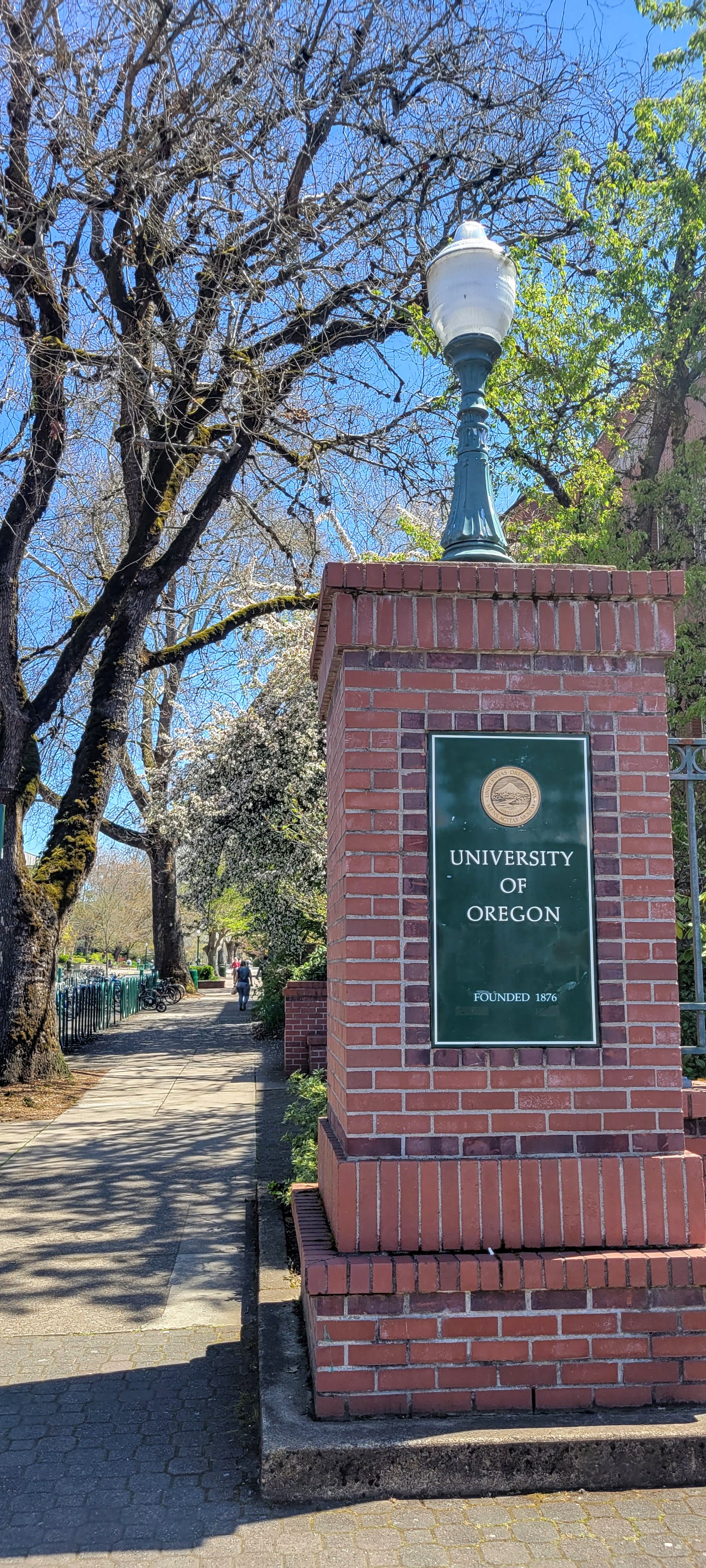
While the university’s formal seal seems to have fallen out of fashion, you can still find it etched here and there on campus with its Latin motto: mens agitat molem. This translates to something along the lines of “the mind moves matter,” which is fine, I guess. But I spent my undergraduate years slightly mistranslating it as, “minds move mountains,” which I thought sounded pretty cool. I liked the idea that investing in my mind could harness the power needed to shift something seemingly immobile in a new direction.
There’s a lot of discussion today on whether college is still necessary. I think about this as I walk through the school’s grounds. When I take these strolls, I watch the fall term leaves turn brilliant reds, oranges, and yellows until they shrivel to brown and dance their way to the detritus hugged against the sidewalk’s edge. I feel the buzz of 13th Avenue as classes let out twenty and fifty minutes past the hour, hungry students flowing from the buildings with their youthful yearning feeding the hope left in my own heart.
Eugene gets quiet when the students leave. I find I miss the energy they bring to the town, their nascent dreams and thirst for knowledge inching time forward in the most precious and ephemeral of ways. By the time they returned from winter break this year, my own heart had gotten lost somewhere in the dark fog of the season. And so, I took it for a walk last week.
I headed west on 13th Avenue, about forty minutes past the hour. I noticed bikes once again secured with heavy-duty U-locks to green metal racks. I saw barren patches of rain-soaked soil where I knew in another month the first signs of spring would break through late winter’s frost as bright yellow daffodils. And I glimpsed that same wooden bench tucked under a towering spruce where I used to sit as a 20-year-old and call my dad—plump tears perched on my bottom eyelashes and a quiver in my voice, not able to quite see the path forward yet.
And he’d tell me, “It’s going to be OK.”
He’d explain, “Cream rises.”
He’d reassure me, “You’re going to be alright.”
And I would take a deep breath and for a moment feel held and seen enough to wipe my tears with the back of my hand, pick up my book bag, and keep walking toward whatever dream was next, whichever path presented itself.
As I continued walking in the present day, about forty-five minutes past the hour, my heart ached wondering if I’d ever have a college student of my own to reassure, to believe in, to watch steadfastly crawl and tumble and run and parade and march their way toward some deeper knowing and some even deeper new question.
And then at fifty minutes past the hour, the magic of campus began. Once quiet sidewalks were soon bustling with students—heading to their next class, back to the dorm, to office hours, to meet up with a friend, to study in the library. And the part of me that felt powerless at that moment, the younger part that remembered how hard some of those glory days could be, found a quiet strength in what I knew I could still offer them: love. As I walked, I sent care toward them as we passed, knowing that some may be needing it without feeling like they had access to it or the language to ask for it.
To the girl with the Jansport bag: “You’re doing great, sweetie.”
To the boy with the tangled hair: “It’s going to be OK; you’re already enough.”
To the student staring at the middle distance: “I see you and I believe in your dreams.”
And I put my hand on my own heart for a moment. I felt 20-year-old Korrin in there and I sent her reassurance too. I told her she did great. I let her know we’re still figuring it out. I reminded her that we’re not alone.
I circled the quad, paralleled the library, and began listening to the students as I passed, curious about what I could learn from their own snippets of conversation.
One bro to another bro: “At least the shortest day is behind us; it happened in December.”
Gal pal to gal pal: “If this man is going to be in my life, then things need to change because I shouldn’t be wasting my time like this.”
Gal pal in affirmation: “That’s such a great mindset.”
Woman walking while talking on the phone: “You know, you’re going to be OK.”
Another girl on the phone: “Hi, I just wanted to call and ask for some advice.”
And then I glimpsed the signs of so many lived lives as I passed the dorms on my loop back to where I began, smiling at a cluster of post-it notes arranged on a window to say “hi.” And I smiled and felt held.
There are many places and ways to find oneself. What’s also true is that there’s something special about the college experience, the melding together of knowledge and socializing, the learning how to fly while still figuring out that you even have wings in the first place.
College can teach us about the perfect piece of 19th century art to use an anchor point when trying to wade through murky endings. It can offer us that line of poetry from the English professor who told us we knew how to write and should keep doing it. It can bring us the advisor who makes us believe in ourselves enough to apply for that opportunity on the other side of the country, and who welcomes us back with open arms over a decade later when we make another choice.
College lets us learn about ourselves, yes, but perhaps more importantly, it provides a space to explore our connections and relationships, too—how we can show up for each other, how to see another person deeply and be beside them when the ground they stand on shifts.
Mark Nepo wrote that, “To listen is to lean in softly with the willingness to be changed by what we hear.” And college, to me, brings this wisdom to the surface in unexpected ways. A college campus isn’t just a place for new ideas, but also for an awareness of the things that never change.
It is nearly impossible to get through this life without falling down at least once. At some point, the unthinkable happens, and we have to figure out how to get back up and dream a new dream. We have to call for extra support when it’s too much for us to hold on our own, or when we know there’s something else up ahead, but we can’t quite make out its shape yet. Our friend from the dorm needs to be there to hold our hand and remind us to breathe when it hurts. Another needs to lend us their car when ours is away in the shop, to sit with us over a tearful lunch, to be a new face in a coffeeshop one night with knowing eyes and a compassionate heart.
I’m not sure if I’ll ever have a college student of my own, but I still want to help raise good humans in a caring community. I still want to learn to grow and listen with those closest to me. And the inquiries that college can raise for students, of any age, still feel valuable to me, still necessary—but it’s the mixing of those with the realities of life and love that makes the experience potent.
I once thought that “minds move mountains” was admirable, but the curiosity that my college experience afforded me also made me realize that our motto is lacking—a mind without heart simply isn’t enough. (I mean, did anyone even ask the mountain how it felt about being moved?) I never learned Latin, so I can’t fix it, but given what I see on my weekly walks around campus, I bet I can find a heart-led student who can.
 ROUGH OUTLINES